Saturday, 21 May 2022
Sunday, 10 April 2022
Wednesday, 16 March 2022
Wednesday, 23 February 2022
“Plenty of room, plenty of visibility, and plenty of all-around big-car comfort are built into the luxurious new Fisher Body of this Futuramic 4-Door Sedan. There’s greater smoothness in the ‘no-shift, no-clutch’ action of GM Hydra-Matic Drive, and greater safety in the swift, sure acceleration of that Hydra-Matic feature, Whirlaway!”
Sunday, 23 January 2022
Tuesday, 16 February 2021
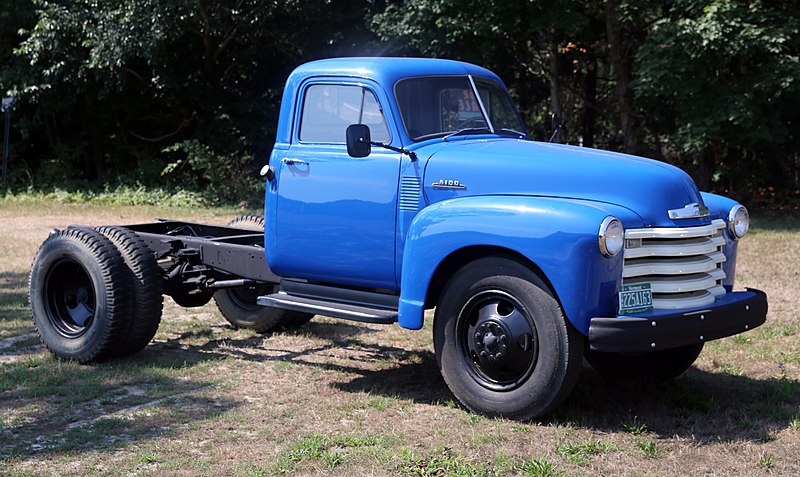
“You get a better, longer lasting return on the dollars you invest in a Chevrolet Advance-Design truck. You get quality, powerful performance, handling ease at their best — and at the lowest list price in the entire truck field. See your Chevrolet dealer. He’s got the right truck for you.”
Trucks aren’t the focus of this blog, but we think this Chevrolet COE, model 5703, is quite interesting, not only because of its unconventional look, but also in its historic context.
During the postwar years, all American car makers sold warmed-up prewar designs. The demand for new cars was huge anyway, and developing an all-new design was a vanity rather than a necessity. GM, back then the undisputed trendsetter in car styling, quite surprisingly choose commercial vehicles to herald its all-new postwar design direction: the “Advance-Design” series of trucks entered production already in May 1947, one full year ahead of the new passenger cars. It’s debatable why GM rushed out the trucks first. One theory suggests that truck production never stopped during wartime, and thus, the body dies were probably worn out by 1946. And reproducing new dies of the old design, or creating entirely new sets would be a similar investment.
Strangely enough it’s pretty well-documented who designed the new Cadillac or Chevrolet models, but there’s no mention of the designers of GM commercial vehicles. We guess it simply wasn’t a prestigious job, and these trucks were styled alongside the passenger cars in the GM styling studios, as there was no dedicated commercial design studio either.
Whatever the case, the nameless GM designers applied all modern treats to these new trucks. At the time, their styling and detailing were thoroughly modern. There was a proper onslaught of variations and sizes, too, from pickup truck to lorry, meeting every conceivable demand. Chevrolet’s copywriters counted “109 models on 8 wheelbases” for the 1948 lineup.
Our pictured COE (read: „Cab Over Engine”) was the fruit of creatively dealing with the legislation: as the overall length for trucks was limited, the cab of the standard truck simply was lifted atop the engine to gain a few more inches of cargo space. Reconnecting the front grille to the higher cowl line required a very bulbous bonnet, and voila, ready was one very peculiar looking truck design.
The „Advance-Design“ COE was built virtually unchanged between 1947 and 1955, but little details narrow down the year in which our pictured truck was produced. The two-piece door glass with separate ventilation pane was introduced in 1951, and push-button door handles came in 1952. The “Chevrolet” bonnet emblems disappeared in 1953, and for 1954, the windshield became an one-piece curved glass. Hence, our pictured truck was produced in 1952. And despite its vintage, it’s still going strong in daily service as a particular (read: privately owned) transport. Because the state-owned bus network is notoriously unreliable, trucks like these remain being the indispensable people hauler in Cuba’s rural areas.
Friday, 22 January 2021
Thursday, 14 January 2021
"Just because Biscayne is our lowest priced, bet you thought it might look a little bit frumpy. Well, look again and ask yourself how we can do it for this kind of money. Or, for that matter, why no one else does it for this kind of money."
In matte blue color, this Chevy Biscayne from Santa Clara might get lost in the shuffle elsewhere, but on the Cuban car market this car holds immense value, just because it is less vintage than any regular cacharro.
When new in 1969, the Chevrolet was good looking, but didn't stand out in any other way. It was plainly a very average car. The shift towards sportiness and flamboyant styling that had characterized GM's budget brand in the 1950s, was long forgotten, and replaced by stuffy characteristics such as reliability, low upkeep and a cushiony ride. Somehow, the roomy, comfortable Chevy was the period equivalent of today's Toyota Camry. Well, in case you’re wondering: we'd still rather take the Chevy...
Wednesday, 6 January 2021
Since its inception in 1926, Pontiac was essentially an upscale Chevrolet, positioned to bridge the gap between the budget make and GM’s more prestigious brands on Alfred P. Sloan’s fine-tuned hierarchy ladder that promised “A Car For Every Purse And Purpose”. At that it fared pretty well, especially if you consider that apart from bespoke engines the Pontiac shared most of its components with Chevrolet.
Pontiac customers had an easy choice in 1952: the Chieftain was the only trim line offered after the Streamliner fastback models were dropped in 1951. You only had to select your preferred bodystyle and color, and decide between six- or eight cylinder engine options.
All 1952 Pontiac and Chevrolet models were based on the corporate GM “A-body”. But to justify its lusher appearance and higher price tag, the Pontiac was stretched by 5.6 inches (14,2 cm) and had a 5-inch (12,7 cm) longer wheelbase than its plebeian counterpart. The additional length didn’t offer much benefit at all, though, except for bragging rights: between windshield and rear wheels, Pontiac and Chevrolet were identical, sharing the same cabin and interior space. The extra bulk was merely added to trunk and bonnet.
However, the gleaming opulence of the Pontiac was popular with the customers and looked attractive, as you can still witness on the pictured convertible from Havana. Despite the bonnie looks, this car is a workhorse, used as a sightseeing ride from dawn till dusk, so the tourists can enjoy “authentic” time travel into the 1950s in exchange for much needed hard currency.
Thursday, 30 July 2020
„Big beauty in everything but price is this highly popular six-passenger Sedan with true de luxe finish throughout. As spirited in action as it is in appearance, this luxury traveler is also a budget-pleasing buy.”
In 1952, you could order your Buick in no less than 45 color combinations out of 21 body- and 6 roof colors. Quite a lot of hues, but probably not as many as the motley mix of shades that adorn our pictured Buick.
The 1952 Buick Special differed merely in cosmetic details from the previous year. Most notable outside was a different “sweep spear” trim design and the addition of small metal “tail fins” at the rear fenders.
Buick customers looking for a 4-door sedan could choose between two versions: a base version, Model 41, and the better appointed Deluxe Sedan, Model 41D, pictured here. A modest 46$ markup for the higher version made it an extremely popular upgrade with the affluent Buick clientele: 63,346 Deluxe Sedans left the factory in 1952, but only 137 base models. Which incidentally makes the cheaper „Plain Jane“ far more collectible today.
Tuesday, 21 July 2020

“Chevy does beautifully by your budget! Take that Biscayne 2-Door up above. It’s fresh and fashionable, a full size family car with wide, soft-cushioned seats and wonderful visibility. With remarkable handling ease and road steadiness. A new kind of finish that’ll go years without waxing. With all power teams available, too, including a new 6 that saves and saves on gas. Yet, it’s Chevy’s lowest priced sedan!”
Sunday, 19 April 2020
"New styling that stays new. Fresh, new 1954 styling outside and in makes Chevrolet even more of a stand-out. And there's an exciting choice of rich new colors that harmonize with the new and more colorful interiors."
Somehow, the advertisement claim fits well to this colorful Chevy from Havana. The chrome moldings around the windows and the holes for the missing chrome decor in the front fender indicate that it's a "Two-Ten" Sedan, the intermediate trim-level of Chevrolet's lineup for 1954. The new models, introduced in 1953 and face-lifted for 1954, sported a slightly boxier design than their predecessors, with improvements in packaging, such as larger trunk openings and greater shoulder room for the passengers. The tried-and-trusted "Blue Flame" 6-cylinder engines still had to serve, which gave Chevrolet a disadvantage to Ford, who just had introduced a popular V-8 option. Anyway, Chevrolets engineers were already working on a V-8 engine for 1955, which would become a smash hit with the customers.
Saturday, 21 March 2020
„Many Significant Changes are found throughout the new B-58 Buick, since a great many projects long under development suddenly came to full flower this year, in this car: the Dynastar Grille, the clean, fresh styling, the ‚velvet wall‘ sound silencing, the new Quadrajet Carburetor, the Air-Cooled Aluminum Brakes,* and many others. Best thing any knowing car buyer can do is drop in on his Buick dealer at the first opportunity to take a good look at these B-58’s, then drive one and let it speak for itself.“
The "Airborn '58 Buick" is waiting for its driver in the early morning sun. It's quite a rare sight to see a vintage American car registered to a state owned enterprise. This car belongs to the "Empresa La Vega" in Sancti Spiritus, and while the typical socialist company cars are Ladas or other models of Russian origin, the honored driver of this vintage Buick can do his business in style.
The Cuban government uses to seize the cars (and all other properties) of cuban citizens that leave the country, and put it in the hands of the "pueblo" Well, hardly ever the "pueblo" receives the donations... We guess in this was way the Buick Special found its new, public owner.
1958 was a difficult year for Buick: launched amidst the first post-war recession, the new lineup was miles away from the customer's expectations, as „compact cars“ became all the rage. The Buick's dimensions and design, instead, were a typical excess at the climax of the "chrome-and-tailfins" era, and while the catalog promised: "the first big car that is light on it's feet", in reality these cars were heavy-handed and drove accordingly. Less than 250,000 Buicks found new owners in 1958, down from 405,000 cars in 1957, and a massive drop from the 740,000 cars that were sold in the record-breaking year of 1955.
Thursday, 2 January 2020

„You see the new personality of the 1957 Pontiac Laurentian with the first thrilling look at the graceful, longer, lower silhouette. From bumper to road-hugging bumper there is a new dash — a new sensational feeling of vitality and color that makes Laurentian the car with the most sweeping change of all.“
„Laurentian“ is a badge that only sounds familiar to Canadian motorists, and makes our pictured Pontiac an international affair: an American car that was built in Canada to be sold in Cuba. Before 1959, the wealthy island was the biggest export market for the American manufacturers. But many cars that were sold here actually arrived from Canada.
Canada was a tough market for the protagonists from Detroit since the early days of the automobile. The Canadian government applied tariffs up to 35% on imported cars and parts, which forced the car makers to set up their own factories within the territory of the northern neighbor. Chrysler and Ford produced in Windsor, just across the Detroit river, while Henry Durant had established its Canadian business together with the Laughlin Motor Company of Oshawa near Toronto, and since 1915 all Canadian Chevrolet models were produced there.
Economic pressure spawns creativity, and soon the manufacturers began offering their pricier mid-level lines based on national budget models: Canadian Dodges and DeSotos were merely Plymouths with distinctive front ends, while Pontiacs became Chevrolets in disguise. The advantage of that practice were lower production costs, which made the Canadian cars great for price-sensitive export markets. New entry-level cars sold in Cuba generally came from Canada, hence today you can find DeSoto, Dodge or Pontiac badges that didn’t exist in the U.S., driving alongside their „original“ peers from Detroit.
Back to the „Laurentian“: aside from the sheet metal, this Pontiac is essentially a Chevrolet, as engine, drivetrain, chassis and most body parts are 100% Chevy. While they certainly looked like Pontiacs, these Canadian cars were 5 inches (12,7cm) shorter than their Detroit-built counterparts. And you could still order a 6-cylinder engine (from Chevrolet, of course), that was missing from the American Pontiac catalogue since 1955.
Sunday, 18 December 2016

"It's shaped to the new American taste with a lean, clean silhouette, crisp new contours, beautifully restrained accents. It has a bright new sheen — a new kind of finish that keeps its luster without waxing for up to three years. In fact, Chevy's new right down to its tires!"
Even with plastic hubcaps and aftermarket mirrors this Chevrolet Impala from Cienfuegos is still a dandy looking car. "Impala", introduced in 1958 as a special trim option, replaced the "Bel Air" at the top end of Chevrolet's lineup in 1959, and introducing the unique "floating" hardtop roof with its technically demanding wraparound rear window was perhaps the smartest way to flaunt the news. Conservative buyers could still spec their Impala with a conventional roof, however.
Chevrolet shared this novel roof design with the other GM divisions, just as they all shared the front doors which originated from the 1959 Buick. Because GM's bean counters demanded cost saving measures, all 1959 GM models should feature the same, strangely dropping shoulder line right behind the A-post.
Chevrolet's copywriters weren't shy on superlatives to make the new models tempting for the customers: "The 1959 Chevrolet is more than new — it's your kind of car. Shaped to reward your new taste in style. Designed to anticipate your desire for greater roominess and comfort. Engineered to bring you greater safety, economy, ease of handling and smoothness of ride. Chevrolet's new Slimline design brings entirely new poise and proportion to automobile styling. Inside the new and roomier Body by Fisher you'll find truly tasteful elegance. And you'll see more through the big new Vista-Panoramic windshield that curves overhead."
Tuesday, 13 December 2016

"Meet the sit-up-and-notice car of the year! Big! Beautiful! Packed with power and loaded with value from its 280-h.p. Rocket Engine to its 17-cubic-foot trunk storage area. Everywhere you'll find that extra measure of Oldsmobile quality: handsomely appointed interiors with deep-cushioned seats; Magic-Mirror Finishes; four-coil spring suspension on a road-leveling 123-inch wheelbase. Drive a '64 Dynamic 88 soon. You'll love it! It's that kind of car!"
This Oldsmobile from Havana's lovely Miramar district is one of those American automobiles that seem out of place in Cuba, as they are from a time when the U.S. trade embargo against the island was already in full effect. The words of owner Olvidio make the provenance of his car all the more interesting: "Fidel, el comandante en jefe, bought twelve of these Oldsmobiles for the bodyguards of his guardia de espalda. Mine is the only hardtop of the bunch, while the others were regular sedans." It needs to be taken with a grain of salt, but Fidel Castro's affinity to Oldsmobiles is well documented, and makes this scenario imaginable. The potent yet understated looking Oldsmobiles would be a perfect choice for service in Castro's escort.
The Oldsmobile for 1964 was a typical design of the Bill Mitchell era at General Motors. Mitchell preferred a look that he called „London Tailoring“: clean, simple volumes, juxtaposed with crisp edges and an emphasis on horizontal lines to stretch the car optically. Yet, their rather understated styling didn't show that the Oldsmobiles were among the most potent cars in the GM portfolio. When new, the pictured 1964 Oldsmobile Dynamic 88 came standard with a 280hp "Rocket V-8" engine, which years ago had to make way for the Ssangyong Diesel that powers it today.
Thursday, 8 September 2016

"You expect something pretty special in the way of driving pleasure the very first time you take charge of a new Chevrolet. Those clean, graceful contours hold a promise of quicksilver responsiveness. And there's something about the low, action-poised profile that tells you Chevy's a honey to handle.
It doesn't take long to find out that this car lives up to all its 'advanced notice' — and then some! Horsepower ranging up to 245* translates your toe-touch into cream-smooth motion. You find that turning a corner is almost as easy as making a wish. And you see how Chevrolet's solid sureness of control makes for safer, happier driving on city streets, superhighways and everything in between."
The right set of wheels and a proper suspension setup make even an ordinary bread-and-butter Chevrolet look pretty special.
The Two-Ten was the sensible choice if you were in the game for a new Chevrolet: it offered most of the bells and whistles of the range-topping Bel Air, save for the dashing rear fender panels, made out of anodized aluminum, and some glossy trim details. Yet, the 1950s were expressive times, and most buyers would rather spend an extra $100 to show their neighbors that they could afford the flashiest of the new Chevrolets.
Or they went to buy the all-new 1957 Ford, instead. While its classic styling makes the 1957 Chevrolet a prized 1950s icon today, at the time most buyers considered the Ford looking more modern and attractive and ergo Chevrolet was outsold by its perennial competitor for the first time since 1935.
Saturday, 20 August 2016

"The New Style in Postwar Driving! Oldsmobile's smart new style is more than a matter of smooth, flowing lines, ultra-modern trim, and tasteful interiors. It's a new style of driving, too . . . the Hydra-Matic way . . . the easiest way of driving ever devised. No gear shifting to think about. No clutch pedal to bother with. Hydra-Matic Drive is the nearest thing yet to completely automatic driving. Just step on the gas and away you go . . . in style . . . in the brilliant new Oldsmobile with General Motors' new Hydra-Matic Drive."
This Oldsmobile from Havana shows off really dramatic proportions: the massive bonnet and front fenders create a stark contrast to the taut fastback cabin and make the car look a bit like a Bulldog on wheels.
Just like most American car manufacturers, Oldsmobile offered warmed-up prewar designs through 1948. Thus, the 1946 models were merely 1942 cars with updated trim. The little changes, however, did the Oldsmobile well, as the designers somehow had got lost in a very ornate front grille design in the early 1940s. For 1946, simple horizontal bars were introduced, which suited to the overall rather clean Oldsmobile design in a much better way.
More than styling, the noteworthy feature at Oldsmobile anyway was Hydra-Matic. This automatic transmission, developed in a joint effort between Cadillac and Oldsmobile, became exclusively available in the 1940 Oldsmobiles, while Cadillac jumped on the bandwagon one year later: apparently, GM didn't want to risk ruining the reputation of Cadillac in case the new technology was flawed.
But the Hydra-Matic was reliable and should become very popular: by February 1942, more than 210,000 cars were equipped with the new transmission. The trend gained momentum in postwar times. In 1948, when Pontiac introduced Hydra-Matic, 73% of buyers opted for the new transmission. In the same year, more than 90% of Cadillacs and nearly all Oldsmobiles were equipped with the auto tranny.
GM even sold the transmission to its competitors, and by the early 1950s, Lincoln, Nash, Hudson and Kaiser-Frazer equipped their cars with Hydra-Matic, too.
Saturday, 13 August 2016

"Cadillac's many and varied contributions to the cause of automotive progress have, over the years, represented one of the most important and inspiring traditions in all motordom. And in styling, in design and in engineering, the latest 'car of cars' has added dramatic emphasis to this fact of Cadillac leadership. If you have not yet inspected its marvelous new Fleetwood coachcrafting — or experienced its brilliant new performance — you should do so soon."
Noble understatement was never a trait of Cadillac's advertisement. Especially throughout the 1950s, GM's luxury division cultivated the image of being "Standard of the World", suggesting that everyone was following. Yet, the company's proclaimed "various contributions to the cause of automotive progress" definitely didn't include a station wagon. It took Cuban craftsmen to complete the unfinished task.
The linear window graphics of this rather clumsy rework actually create fairly extreme proportions which somehow suit the Cadillac design. Harley Earl certainly would be pleased to see his mantra of "longer and lower" looking cars in full effect here, even if an original Cadillac station wagon would probably look more baroque and opulent than our pictured model.
"Baroque" seemed to be the underlying theme for all GM designs in 1958. That year, the models turned into garish chrome monsters. Among them, the Cadillac still looked surprisingly decent. Novel quad headlights and a wider front grille should make the 1958 Cadillacs look different but certainly not better than their predecessors, and probably many customers thought the same. Cadillac's sales didn't nosedive as sharp as most other "Full-size" cars in 1958, yet they took a serious hit. Even if the luxury segment wasn't really affected from the buyer's sudden turn to economic "compact" cars, the Cadillacs sold badly that year. Thus, 1958 Cadillacs aren't common in Cuba today, either. This genuine example over at Caristas nicely illustrates how the 1958 Cadillac looked before its station wagon conversion.
Thursday, 28 April 2016

"Long the favorite of the world's most discerning families, the Cadillac Series 62 Sedan again features generously proportioned interiors, now more beautifully and luxuriously appointed than ever before. Like all 1955 Cadillacs, it offers superb riding comfort and markedly easy handling. Its look of length and lowness is evidence of its remarkable stability and handling sureness. The Series 62 Sedan is truly one of the finest family cars on the road today."
The fact that plenty of 1955 Cadillacs are still driving on Cuban roads speaks volumes about the quality of these magnificent automobiles. And about their popularity among the wealthy Cubans that enthusiastically bought them back in the day. In those prosperous years, Cuba's urban society was on the upswing, and there was obviously plenty of the necessary dinero available to afford this American extravaganza.
Since the late 1940s, Cadillac had been the rising star among America's established luxury car makers. Careful product planning and an evolutionary design strategy led to a popularity that was previously unseen in that segment: Cadillac sold 140,477 cars in 1955, 44,097 more than in the year before.
That sales surge seems a bit odd, as 1955 was merely a year of little cosmetic refinements at Cadillac. Yet, changing a successful formula was all but necessary, as you can witness on our pictured photo model: its well balanced proportions and its —for the time's taste— restrained flamboyance give the Cadillac a timeless dignity that perfectly suited the image of America's most desirable luxury brand.